Umul
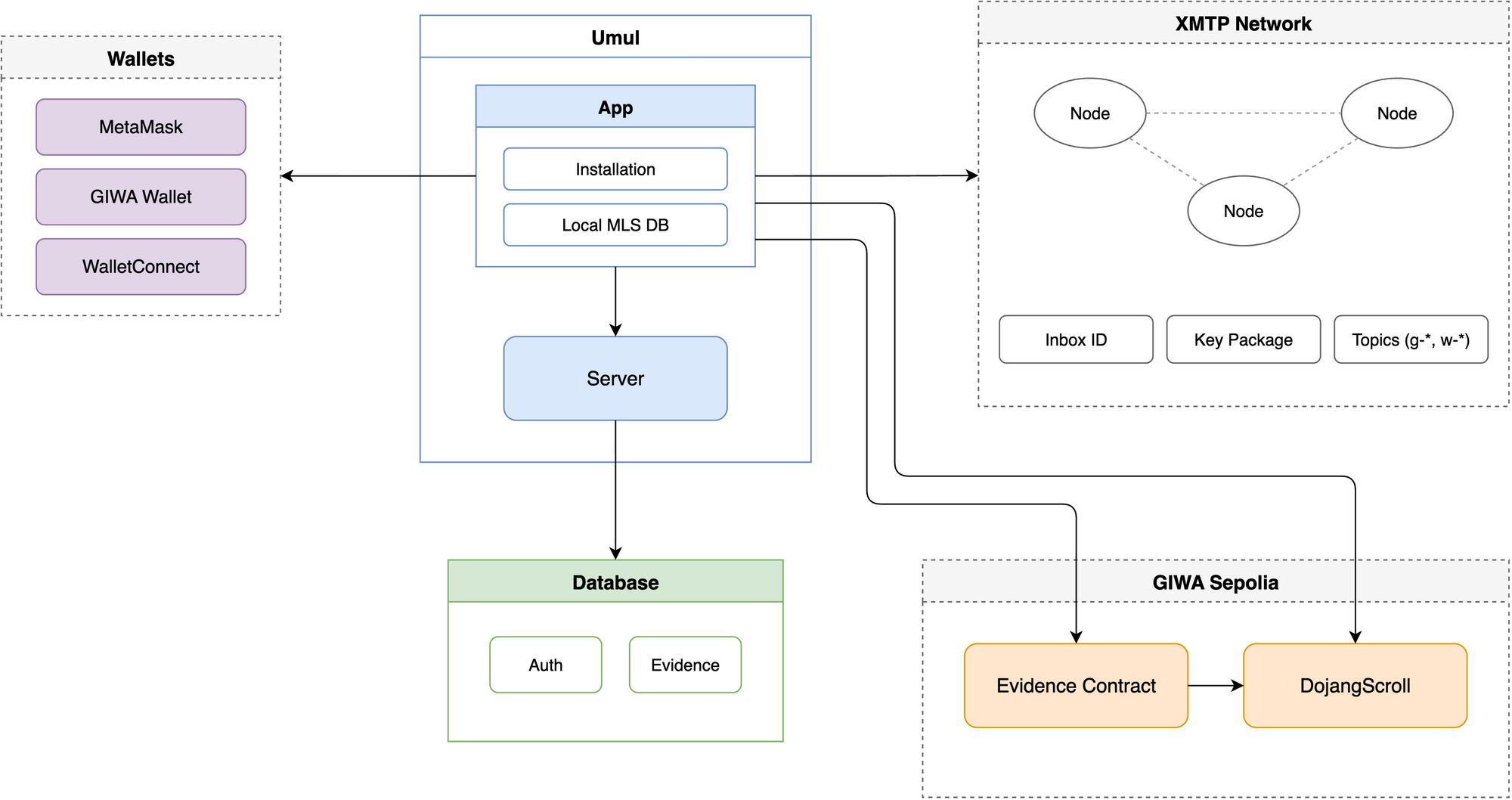
Umul is a mobile-shaped web messenger where you sign in with a wallet address and talk over the XMTP network. Dojang verification status drives peer badges and inbox routing, and only conversations where every participant is verified can be recorded as evidence on GIWA Sepolia.
Why "Umul"
Umul (우물) is Korean for a well. The wellside was where villagers gathered and talked — a shared space owned by no one in particular, used by everyone, where each person brought their own bucket to draw water.
Umul is built the same way. Accounts and conversations live on the shared XMTP network rather than inside one app, and the keys that open them exist only in each person's wallet and devices. The server tends the well but cannot look into the water.
And as a deep well does not run dry, a conversation every participant agreed to stays on chain, verifiable long after the fact.
Core ideas
- The wallet is the identity. You sign in SIWE-style with no separate account, and the messaging identity (XMTP Inbox) is created from a wallet signature as well.
- Message plaintext never reaches the server. Conversations travel under XMTP MLS end-to-end encryption, and decrypted plaintext lives only in each device's local storage. Only hashes go to the server and the chain.
- Evidence holds only with everyone's signature. Every participant must recompute the same hash from the same plaintext and sign it under EIP-712 before anything is recorded on chain.
- Evidence plaintext is stored only as ciphertext. The client encrypts a conversation used for evidence before handing it to the server, and only wallets that actually signed can restore it — at any time, with a single wallet signature. The server never received a key, so it cannot open it.
Network
| Item | Value |
|---|---|
| Messaging | XMTP dev |
| Chain | GIWA Sepolia (chain ID 91342) |
| DojangScroll | 0xd5077b67dcb56caC8b270C7788FC3E6ee03F17B9 |
| Evidence contract | 0x675dB91aCEC52DCb44e6d20FB1F1299FFafBb51B |
Where to start
- For the structure, read System Design
- For screen behaviour and call order, User Flows
- For how messaging works, XMTP Overview
- To understand evidence from scratch, the Evidence Contract Guide